2Minutes: Promises In JavaScript
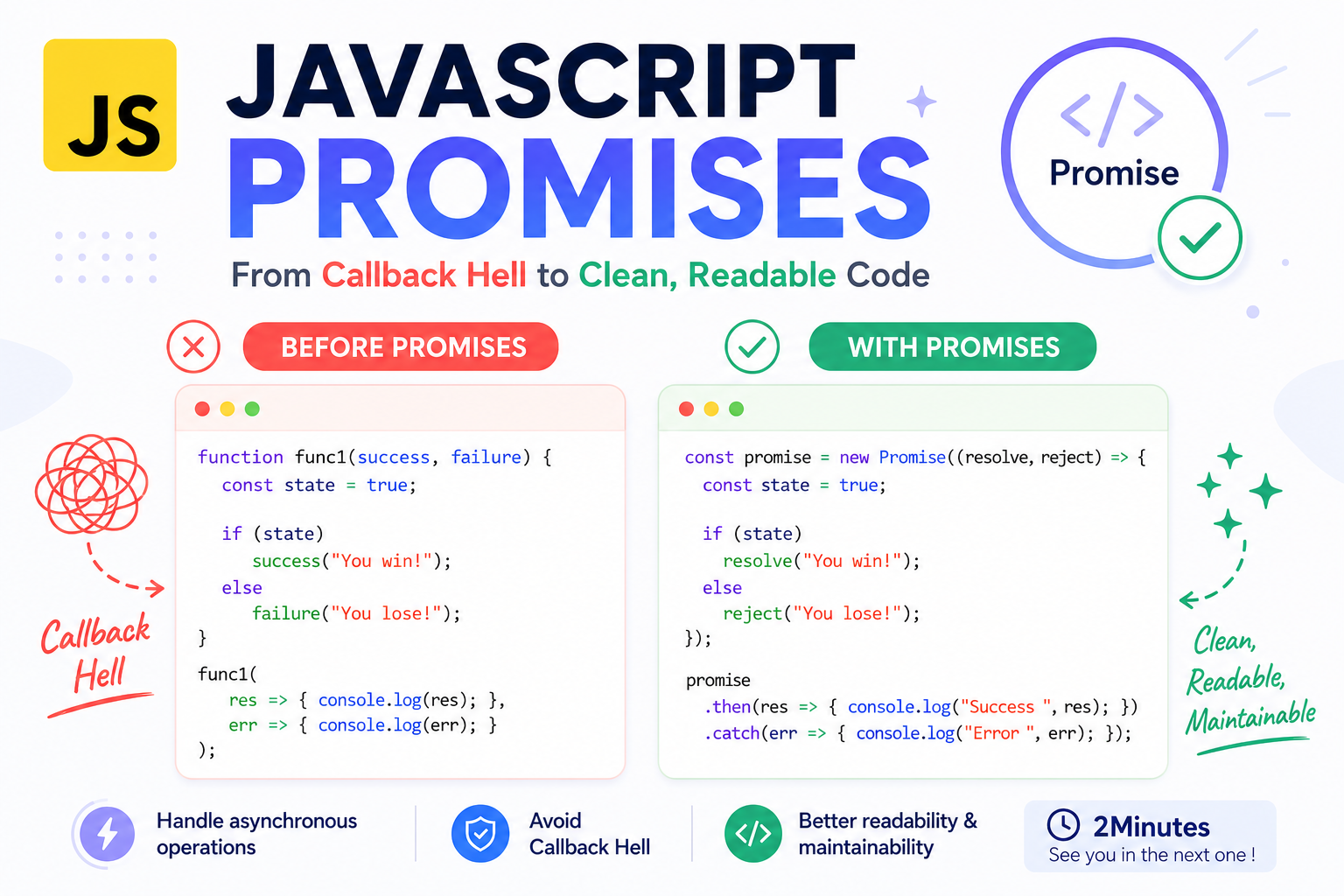
In JavaScript, when we want to perform asynchronous operations, we use Promises. They also help us avoid “Callback Hell,” a situation where nested callbacks make code difficult to read, understand, and maintain. Search for “Callback Hell” to see how quickly code can become hard to follow.
// Before Promises
function func1(success, failure) {
  const state = true;

  if (state)
    success("You win!");
  else
    failure("You lose!");
}

func1(
  res => {
    console.log(res);
  },
  err => {
    console.log(err);
  }
);

// With Promises
const promise = new Promise((resolve, reject) => {
  const state = true;

  if (state)
    resolve("You win!");
  else
    reject("You lose!");
});

promise
  .then(res => {
    console.log("Success ", res);
  })
  .catch(err => {
    console.log("Error ", err);
});Definitely the second one looks cleaner, readable, and more maintainable.
A Promise always returns a Promise object. There are two main ways to handle its result: either with .then() and .catch(), which we covered in the previous example, or with async/await, which we’ll explore in upcoming posts, in shāʾ Allāh.
That’s 2Minutes, see you in the next one !
Sources
MDN: https://developer.mozilla.org/en-US/docs/Web/JavaScript/Reference/Global_Objects/Promise
GeeksForGeeks: https://www.geeksforgeeks.org/javascript/javascript-promise/